







 Armenia
 Azerbaijan
 Bulgaria
 Georgia
 Iran
 Kazakhstan
 Kyrgyzstan
 Moldova
 Romania
 Tajikistan
 Türkiye
 Turkmenistan
 Ukraine
 Uzbekistan
TRACECA Presented 5 Digital Priorities at IATA 2026 Forums
From 13 to 15 October, 2026 a series of major aviation forums hosted by IATA took place in Brussels, with the participation of Mr. Jasurbek Choriev, Secretary General of the Permanent Secretariat of the Intergovernmental Commission (PS IGC) TRACECA.
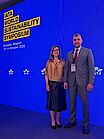
The agenda of the events focused on developing critical policy decisions for the decarbonisation of air transport and accelerating its transition to net-zero carbon emissions by 2050. Participants centred their discussions on scaling the renewable energy market, developing sustainable aviation fuel (SAF), and establishing harmonised standards to balance environmental sustainability with the preservation of competitiveness and the growth of economic connectivity.
During the "Government Leaders" session, the Secretary General emphasised that in the era of multimodal transport development, the aviation sector and land corridors must operate within a unified technological framework. As an example of such integration, he highlighted TRACECA's strategic target: reducing the total delivery time along key routes of the Middle Corridor to 15 days by 2030. The speaker noted that while speed is a baseline standard for aviation, the bulk of time on land and sea sections is currently lost at checkpoints, during cargo transhipment, and when processing paper documents. Consequently, the primary potential for improving the efficiency of the entire logistics corridor lies within the scope of "soft infrastructure" – namely, digitalisation and the elimination of administrative barriers.
During the session, the organisation's 5 key digital priorities were presented. The milestone step in this direction was the signing of the Agreement on a Single Transit Permit by Azerbaijan, Kazakhstan, Kyrgyzstan, Ukraine and Uzbekistan in Astana on 15 May 2026, which replaces an entire package of former national permits along the entire route. "Along with this, the TRACECA agenda covers the digitalisation of the multilateral permit system, the launch of advance cargo information systems, the implementation of electronic queue systems at borders, and other measures," noted J. Choriev.
This set of practical measures, together with the development of the Bottleneck Matrix and the Corridor Performance Index, is enshrined in the draft of the new TRACECA Strategy for 2027-2036 and serves as a clear guideline for EBRD and EIB investments.
To establish a seamless digital environment, TRACECA is simultaneously working on three interconnected levels. The legal foundation is being formed through the preparation of an intergovernmental agreement among seven countries on the mutual recognition of electronic signatures. Technical interoperability is ensured by the development of XML and EDIFACT converters based on UN/CEFACT standards. On the practical level, synergy is achieved through the direct scaling of pilot digital projects along the entire route.
The Secretary General of TRACECA also urged international financial institutions to direct resources towards modernising the IT infrastructure of border agencies, ports, and railways. He noted that targeted investments in digital "weak links" guarantee maximum economic returns and will enable the transition from mere coordination to actual operational leadership on the routes.
Background:
The International Air Transport Association (IATA) represents over 370 airlines worldwide, accounting for approximately 85% of global air traffic. The Association forms a unified technological and legal space for the transport market, and its electronic document management and digital security standards serve as a benchmark for modernising border and transport infrastructure on intercontinental routes.
The development of air transport is of strategic importance for TRACECA. Articles 2 and 3 of the Basic Multilateral Agreement on International Transport for Development of the Corridor Europe-Caucasus-Asia define air transport as an integral part of international transport, the regulation of which aims to facilitate access to the air transport market, harmonise transport policies, and create a level playing field for competition between different types of transport to stimulate regional trade.
Country:
Mode:
Published:
Permanent Secretaritat of the IGC TRACECA
